
That Damn Shadow
How Progressives Lost the Narrative

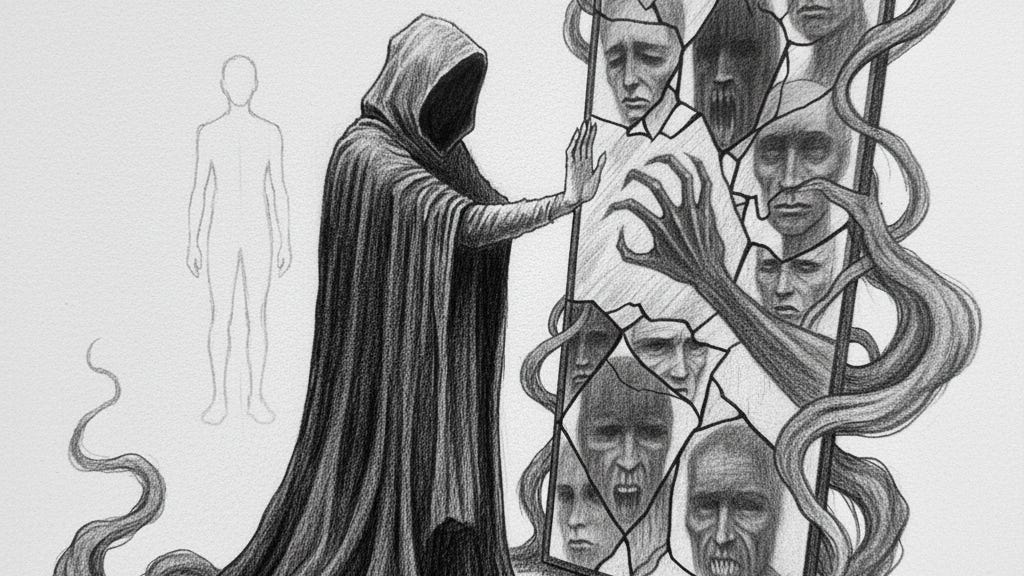
I’m becoming increasingly convinced that the jarring rise of the far right is a massive, painful mirror held up for us to look hard at a progressive ideology that went too far.
We shouldn’t discard the core ideals of progressivism, rather we need to recognize how we drifted into our narcissism. If we have any hope of evolving out of this political morass, we’re going to have to stop pointing fingers and start doing the deep, messy work of healing and integrating our shadow.
The Spiritual Mandate of Integration
This analysis rests on the Jungian concepts of the collective shadow and the spiritual mandate for integration. It lies in the central exhortation of Jesus: love your enemy.
If I am going to genuinely love my enemy and expect them to reciprocate, I have to be certain first that I am lovable. When I look at the progressive movement through this lens of self-reflection, I see a profound failure to be lovable.
What follows are the realizations I came to after analyzing my own thoughts and beliefs which were based on internalized virtues and shadows of the progressive worldview for which I am now repenting. These thoughts are not unique or original but rather gathered over a time of meditation and prayer.
The Shadow
I present these realizations for reflection as the progressive movement’s un-examined flaws that created the vacuum the far right masterfully exploited:
Progressive narcissism is the failure of collective self-reflection. This led to a corrosive identity purity culture.
The movement used its rightful moral claims, like justice and equity, as a shield against criticism and as a self-righteous weapon against dissent. The moral claims were correct; the tactics deployed without empathy or a true commitment to universal inclusion.
By defining itself so absolutely as “the good guys,” the movement refused to acknowledge its own capacity for judgment, arrogance, elitism, and exclusion.
These flaws necessitated the creation of an out-group. The progressives became exceptionally proficient at finding fault in others and even some of its own, while actively avoiding its own culpability in becoming dogmatic and exclusionary.
The resulting narcissistic posture is the inability to hear criticism without interpreting it as a direct, existential attack on the core virtues of the movement. This posture effectively stifled dialogue and created a chilling effect on internal dissent.
Generational pain stemming from real, justifiable, and systemic injustice is profound and must be acknowledged. However, that pain has not yet been fully processed, healed, and integrated into a mature, resilient identity.
Instead of using justified moral rage as a catalyst for unifying, inclusive action, it was often used as an existential accusation. This stance, born from unhealed wounds, created immense and unsustainable moral pressure on those outside the circle of purity.
People are profoundly unlikely to change when they are existentially accused and judged. The progressive movement pushed non-aligned populations away, creating the moral and psychological vacuum that the extreme right exploited.
The hard swing to the right, and the chaos it represents, isn’t just bad luck. It is painful, undeniable feedback to our shadow.
And so, my “repentance” is part of the collective act of honestly acknowledging this shadow, healing the justifiable pain, and prioritizing connection through meaningful, reciprocal relationships, not relationships mediated by algorithms nor moral purity tests.
By integrating my shadow, by becoming humble, and truly inclusive, I can break this toxic cycle and potentially contribute toward healing.
Perhaps then, as I attempt to love my enemy, will I be seen not as an other demanding compliance, but as a fellow traveler, lovable enough for relationships beyond ideology.
Hmm, nobody else responded?
Guy, I sort of agree and sort of totally disagree.
Let me see if I can clarify.
If I take every single one of the negative traits of progressives you describe, I wonder why people think this is anything new. I remember, in the 3 Left wing group meetings I attended in 1971 (thereafter giving up hope that politics of any persuasion could possibly bring about fundamental change in the world) I saw all of this.
When I attended grad school in 1990-1991, it was worse. Just grindingly bad writing (all that literacy criticism language about problematizing and thematizing - they hadn’t got to pronouns yet but I remember putting up a beautiful passage from Ralph Waldo Emerson on the bulletin board and one of my progressive teachers was appalled at all the references to “he” as representing all humanity.
I mean, I didn’t disagree that it was worth looking at, but the condescending schoolmarm attitude did not bode well for acceptance of these kinds of observations.
Now flash forward to the past 10 years - what percentage of Americans who identify with progressive ideals (economic opportunity, health care for all, good quality education for all, etc) were like this (you know, the worst of woke, extreme DEI, etc)
I’d guess maybe 10%?
Well, if 10% of all American adults (that’s 20 million people, I think?) are progressive, and 10% of them represent this tendency, we’re talking about 2 million people in a nation of 350 million.
What percentage of Democrats (not just at the Federal but State levels) are fixated on this kind of woke extremism? I honestly think if you look closely at the bills Bernie and AOC sponsor, you won’t find much there either?
I”m not saying it doesn’t exist. I’m saying the idea that it has ever been widespread is a deliberate fabrication of corporate right wing media.
Am I totally off here? Did you know, by the way, the some wealthy media barons hired David Horowitz (former left wing student radical “mugged by reality” turned exploitative conservative ) to mine the most obscure works of left wing intellectuals (the kind I already found utterly obnoxious int he early 1970s) and find some way (ie lie) to make people think they stood for all Democrats?